Wednesday, 12 September 2012

Pimlico School, John Bancroft

File:Pimlico school entrance.jpg


http://www.annastathaki.com/index.php?/root/wallpapercom/


PimlicoSchool.jpg


Project facts

  • Location: London
  • Country: UK
  • Year of Completion: 1970
  • Client: Unknown
  • Architect: Architects' Department of the Greater London Council John Bancroft
  • Size: Not known
  • Pupils: Not known
  • Construction Sum: Unknown

Overview

Pimlico school was demolished at the start of 2008 amidst an acrimonious debate as to whether this icon of the so called ‘brutalist’ architecture should be saved. The much derided style which is often branded inhumane is disappearing fast and although loved by many architects, public opinion tends to sway towards removing such buildings from the landscape. Pimlico comprehensive school will be re-built as Pimlico Academy in the near future, and it remains to be seen if the school’s new home will be as innovative or controversial as its previous one.
Pimlico school’s appearance was nothing if not striking. Many thought it had a nautical appearance. Part of this aesthetic comes from the elimination of external walls and roofs, which mean a series of planes are folded over to create the building envelope, more akin to naval architecture than land bearing construction. This enabled large areas of glazing to be utilised, creating a light interior. The design of circulation in and around the building was incredibly efficient, with a central internal concourse running the length of the building, reducing the need for meandering lengths of narrow corridors.

Themes

Integrated flexibility for space and learning
The integrated nature of the building form, rather than a series of individual or grouped buildings, enables all of the schools activities to take place under one roof. The main assembly halls, swimming pool and gym are all integral elements in the school building, providing a very compact layout. In order to accommodate all these elements some clever spatial planning was undertaken, with halls being raised up and the pool being sunk into the ground.
Integrated social and physical context
Conceived in the 1960s the building represented a bright new future for architecture and education. The design brought together new construction techniques and conceptual ideas to create a building that acted as a physical symbol of progress, development and learning for the surrounding area.
Innovative solutions to specific areas or smaller spaces
There are a number of innovatively designed spaces within the school that merit further investigation;
The in-the-round assembly hall occupies a lofty position at the top of the building, and represents an egalitarian approach to meeting and performance. The library is a beautifully proportioned space, with a double height central space appropriate for a reading hall and lower ceiling around the edges that is more suitable for individual quiet study. A series of greenhouses run along the edge of the building, connecting the building back to the ground and encouraging the production of food by pupils.
Many of the large strips of glazing are canted to face the sky, with a similarly inclined window sill, encouraging every to look up and be aspirational.

Sources

The Twentieth Century Society, The Pimlico Comprehensive School Website

Building Design Online, 7 March 2008, Demolition of Pimlico School Begins Website


http://www.imagineschooldesign.org/detail.html?&tx_ttnews%5Bpointer%5D=19&tx_ttnews%5Btt_news%5D=3&tx_ttnews%5BbackPid%5D=5&cHash=e1af9ee0d7


In the first of three movies filmed at the Venice Architecture Biennale, Reinier de Graaf of OMA talks about Pimlico School, a brutalist building in London that was demolished last year and which features in OMA’s Public Works exhibition of “masterpieces by bureaucrats” at the biennale.
Reinier de Graf of OMA on masterpieces by bureaucrats
Pimlico School was designed by John Bancroft of the Greater London Council’s architecture department and was constructed in the 1960s. Its demolition to make room for a new building followed a long campaign to have it listed. ”The architect campaigned very actively but he wasn’t a star architect,” de Graaf told Dezeen. “They took him to the demolition site and all he could murmur was ‘bloody fools, bloody fools.’”
Reinier de Graf of OMA on masterpieces by bureaucrats
De Graaf explains that although they weren’t credited by name for their work, architects working in government departments during the 1960 and 1970s created buildings with “enormous vitality and an impressive social mission.”
Reinier de Graf of OMA on masterpieces by bureaucrats


Monday, 13 August 2012

Seoul Memorial Park

Seoul Memorial Park
by HAEAHN Architecture


Seoul Memorial Park by HAEAHN Architecture
This crematorium in Seoul by Korean firm HAEAHN Architecture folds up from the landscape and curls around a peaceful courtyard and pool of water.
Seoul Memorial Park by HAEAHN Architecture
Gardens and ponds run alongside the two-storey building, while grass and plants cover the entire roof.
Seoul Memorial Park by HAEAHN Architecture
Visitors enter beneath a sheltered canopy, before following a procession through the building that trails around the courtyard and ends at one of the gardens.
Seoul Memorial Park by HAEAHN Architecture
Skylights bring natural light into the building from above and are reflected in the polished marble floors.
Seoul Memorial Park by HAEAHN Architecture
We’ve previously featured a few crematoriums, including one with fortress-like walls and dozens of square windows.
Seoul Memorial Park by HAEAHN Architecture
Photography is by Park Youngchae.
Seoul Memorial Park by HAEAHN Architecture
Here’s some more text from the architects:

Seoul Memorial Park
Secluded by mountain hills from a bustling highway gateway, Seoul Memorial Park rests in a serene valley area of the Woo-Myun Mountain on the outskirts of Seoul, South Korea. Seoul Memorial Park is a crematorium constructed in harmony with the natural terrain of the site, which previously lent calming scenic views to meditative passing-by hikers, and is now converted to a sanctuary for solemn rituals concluding life’s journeys.
Seoul Memorial Park by HAEAHN Architecture
Canvas for Land Art
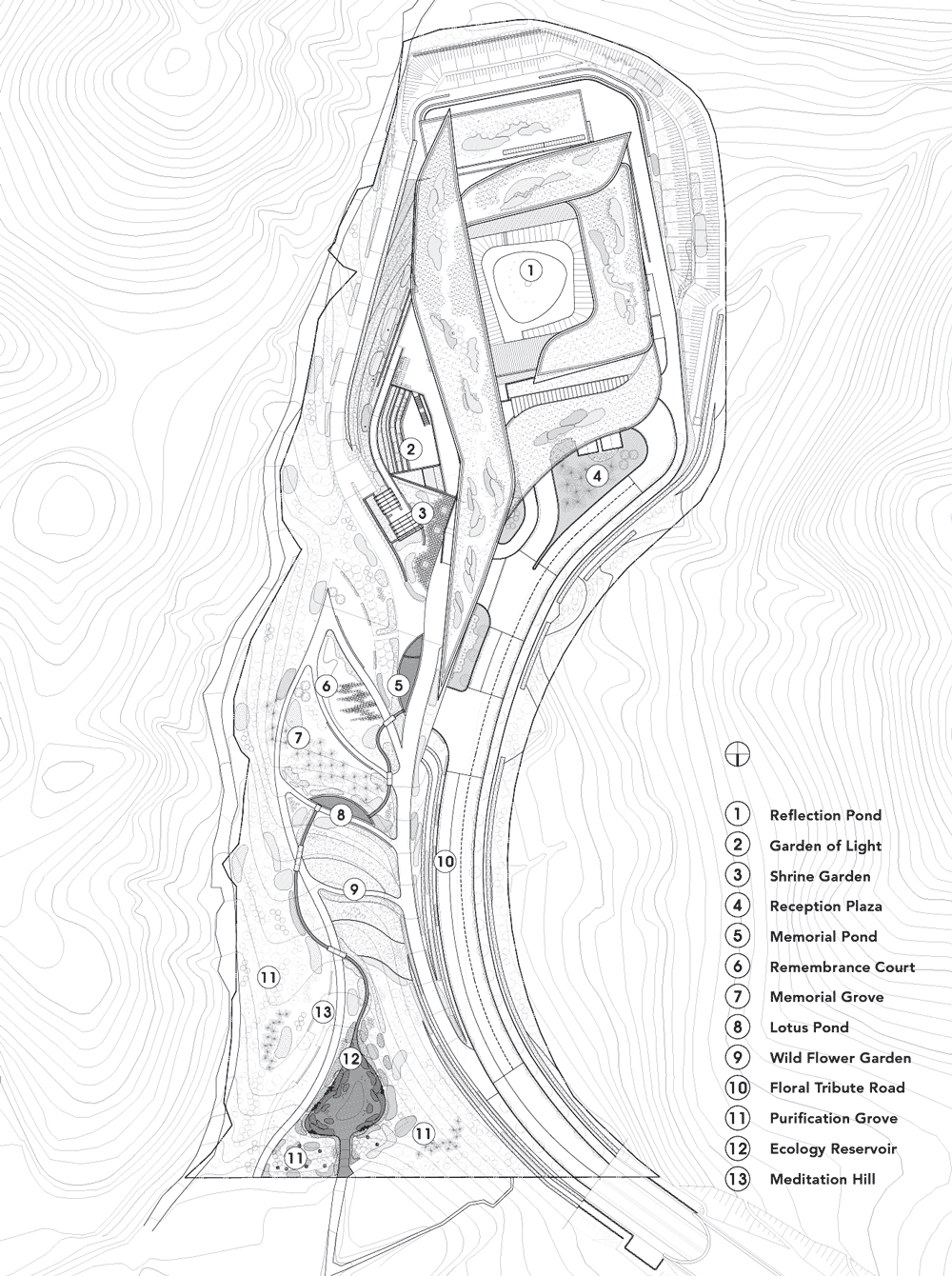
To overcome the unwelcomed response from the community, this crematorium was sought to be a “non-erected” building. Instead, Seoul Memorial Park emerges as a form of “land art” sculpted into the existing topography with a flowing array of architectural forms and motifs. Concaved at the center of the Park, lies a courtyard encompassed by a series of ritual spaces devoted to separate functions.
Seoul Memorial Park by HAEAHN Architecture
Site plan – click above for larger image
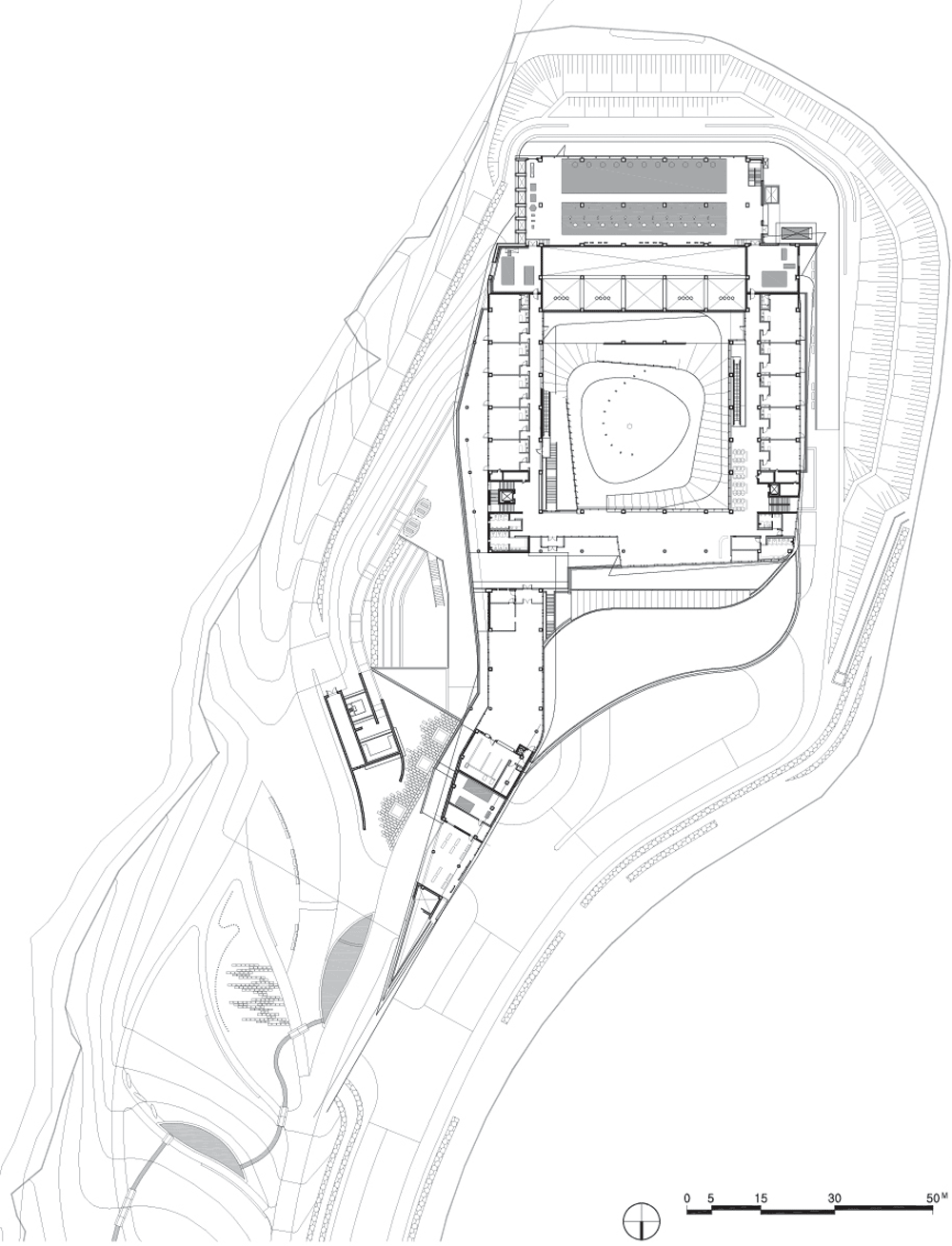
These spatial layers bordering the courtyard resonate from a distance with the surrounding mountain trails and ridges. The 2-storey high crematorium facility configured in the curvilinear belt along the courtyard has roof structures linked in the way flower petals pinwheel one another, punctuated by a reflective pool at the very heart of the courtyard.
Seoul Memorial Park by HAEAHN Architecture
Ground floor plan – click above for larger image
Comfort in the Final Journey
Families in bereavement take the final journey of parting as they encircle the courtyard along a path reminiscent of spiritual spaces with vaulted ceilings and indirect lighting. Towards the cremation alcove, the ceiling rises drastically as a clearstory above a triforum. Upon completion of the path, a meandering garden comforts the bereft.
Seoul Memorial Park by HAEAHN Architecture
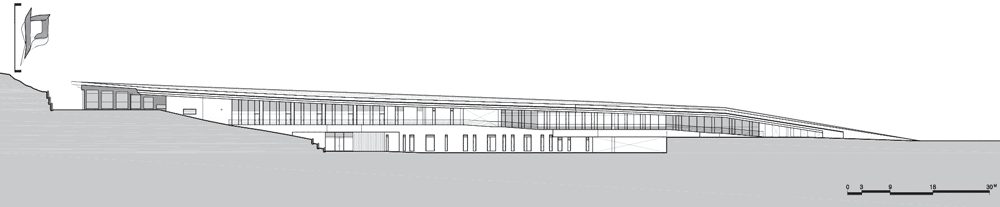
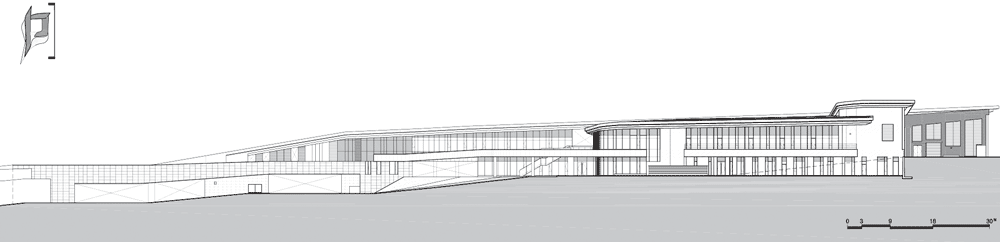
East elevation – click above for larger image
As the water from the mountain flows down and gives life to the garden, one might be reminded of the transfiguration of sorrows in praise of the harmony in nature. The garden shimmers with sunlight, whispers with snowfalls, and dances with spring rains. Season by season, tranquility is discovered and the spirit is renewed. Just as nature was dissolved into a building to rest in the valley, Seoul Memorial Park was embodied in a piece of land art to celebrate life and transfigure sorrows.
Seoul Memorial Park by HAEAHN Architecture
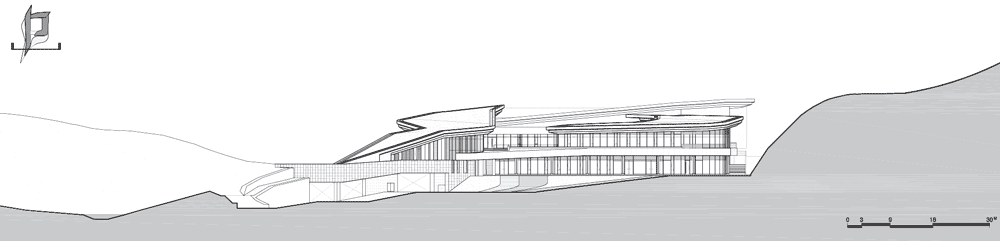
North elevation – click above for larger image
Date of Completion: 2012
Site Area: 36,000 m2
GFA: 18,000 m2
Client: Seoul Municipal Facilities Management Corporation
Seoul Memorial Park by HAEAHN Architecture
West elevation – click above for larger image
2009 winning competition entry and 2012 built project by HAEAHN architecture.

Tuesday, 24 July 2012

Lighting silhouette of house

Building Tilelamp at Casa do Lado
by 20.87

4 comments
Brazilian studio 20.87 has used plastic panels and LED lighting to transform an old house in São Paulo into a giant lamp (+ slideshow).
Building Tilelamp at Casa do Lado by 20.87
The translucent corrugated panels were screwed to a wooden frame placed around the building, allowing the lighting mounted around the edges of the facade to diffuse through.
Building Tilelamp at Casa do Lado by 20.87
The former house is located beside design store MiCasa and is used as a gallery for design exhibitions.
Building Tilelamp at Casa do Lado by 20.87
A previous installation we’ve featured at the building consisted of metal tubing and lamps wrapped around the inside and outside – see it here.
Building Tilelamp at Casa do Lado by 20.87
See more projects in Brazil.
Building Tilelamp at Casa do Lado by 2087
Read more details from the designers below:

The project was developed as a request of design store MiCasa. It consists of the scenographic customization of the adjacent building to the store, in order to host an art exhibition in its interior.
Building Tilelamp at Casa do Lado by 20.87
After the concept was defined, the construction lasted approximately four weeks. To start with, we decided where the LED tapes would be placed.
Building Tilelamp at Casa do Lado by 20.87
Simultaneously, we constructed a wood structure to receive the tile covering.
Building Tilelamp at Casa do Lado by 20.87
With the conclusion of the installation of the lighting, the structure was fixated on the walls of the house at a distance of 20 centimeters from the original construction in order to leave a space between the wall and the tiles, making the lighting more subtle and correcting any sort of irregularities that could be present in the surface of the walls.
Building Tilelamp at Casa do Lado by 20.87
The tiles were custom made for the project and fixated with screws.
Building Tilelamp at Casa do Lado by 20.87
The permanence of the installation is of approximately 6 to 10 months, for a new building will be constructed in the same ground afterwards.

Tuesday, 29 May 2012

Chandigarh by Doshi Levien

Chandigarh by Doshi Levien for Moroso
Milan 2012: London designers Doshi Levien have designed an armchair and sofa for Italian brand Moroso that’s inspired by Modernist architect Le Corbusier and the Indian city of Chandigarh that he masterplanned in the 1950s.
Chandigarh by Doshi Levien for Moroso
The sofa consists of large upholstery pieces, covered in leather or fabric, sitting within a delicate steel frame.
Chandigarh by Doshi Levien for Moroso
Doshi Levien have also designed a Chandigharh-inspired fabric pattern for the sofa as well as a series of coffee tables to compliment the collection.
Chandigarh by Doshi Levien for Moroso
Their work was displayed at the Salone Internazionale del Mobile in April.
Chandigarh by Doshi Levien for Moroso
See all our stories about Milan 2012 here, plus photos on Facebook and Pinterest.
Chandigarh by Doshi Levien for Moroso
See more by Doshi Levien on Dezeen »
See more about Moroso on Dezeen »
Chandigarh by Doshi Levien for Moroso
Here’s some more information from Doshi Levien:

Chandigarh Sofas and tables for Moroso.
The city of Chandigarh in India, known for the architecture by Le Corbusier, is the subject and name of the new collection of sofas by Doshi Levien for Moroso.
Chandigarh by Doshi Levien for Moroso
The principles of modernism, apparently totally unrelated to the city of Chandigarh yet deeply rooted in its identity, have inspired Nipa and Jonathan in the creation of a quintessentially modern seating collection, with a contemporary approach.
Chandigarh by Doshi Levien for Moroso
“For us the Chandigarh sofa is the coming together of modernity, sensuality, graphics and eccentric qualities”, claim the Anglo-Indian designer couple.
Chandigarh by Doshi Levien for Moroso
The Chandigarh sofa is soft and comfortable yet at the same time compact, visually slim and lightweight. The seat is in moulded foam and rests on a frame in iron like a precious stone set in a ring.
Chandigarh by Doshi Levien for Moroso
” The covers are in leather or fabric with a printed pattern designed by Doshi & Levien which pays homage to the memory of the city of Chandigarh.
Chandigarh by Doshi Levien for Moroso
A series of tables compliment the Chandigarh collection, further enriching the architectural material palette using a combination of glass, terrazzo, polished metal and tubular steel.

Cineteca Matadero by

Cineteca Matadero by
Churtichaga+Quadra-Salcedo


Slideshow: Huge glowing baskets surround the staircases of this former slaughterhouse in Madrid that Spanish architects Churtichaga+Quadra-Salcedo have converted into a cinema.
Cineteca Matadero by Churtichaga Quadra-Salcedo
First constructed at the start of the twentieth century, the Cineteca Matadero was used as an abattoir and livestock market for around 85 years, but is now renovated to accomodate two cinema screens, a film studio, an archive and a terrace for outdoor screenings.
Cineteca Matadero by Churtichaga Quadra-Salcedo
The illuminated orange structures dominate the three floors of the film archive, which are otherwise dimly lit and lined with dark grey-painted wood.
Cineteca Matadero by Churtichaga Quadra-Salcedo
Woven walls also surround the two auditoriums but are painted black so as not to detract from the screens.
Cineteca Matadero by Churtichaga Quadra-Salcedo
In the studio areas, the existing brick walls of the hundred-year-old building are mostly left exposed, although some are partially covered with wooden panels.
Cineteca Matadero by Churtichaga Quadra-Salcedo
We’ve published a few unusual conversion projects from Spain recently. See our earlier stories about a market hall converted into a children’s centre and a civic centre inside a former prison.
Cineteca Matadero by Churtichaga Quadra-Salcedo
Photography is by Fernando Guerra.
Cineteca Matadero by Churtichaga Quadra-Salcedo
Here’s a bit more information from Churtichaga+Quadra-Salcedo:

Cinema Center in Matadero de Legazpi, Madrid
Refurbishment and conversion of an old slaughterhouse into a public cinema center housing a film archive, film and television studio, two cinemas, offices, canteen, and summer film patio.

Memory, memories, even bad memory always twist and fly when we work on architectural past, … yes, make a story, choose the tone, cadence, rhythm, accents, a story that naturally coexist with collective memory of the old slaughterhouse of Madrid, with another early report of new application dedicated to the movies while curled up with the forgetfulness of their own recurrent obsessions…
Cineteca Matadero by Churtichaga Quadra-Salcedo
The magical backlight and contrast of the films, and the childhood fascination of basketry and technical human infinite geometries are the sensory triangle… the rest is to surround in spiral this atmosphere, this feeling, and define it constructively.
Cineteca Matadero by Churtichaga Quadra-Salcedo
The tectonic history of brickland, the powerful rhetoric of the old slaughterhouse is the background, and also figure at the scenes of the story, a story in which a continuous low background, a wooden monomaterial painted in dark gray defines the new program deployed on walls, floors and ceilings, allowing a clear separation between story and History.
Cineteca Matadero by Churtichaga Quadra-Salcedo
Against this dark carpet background, my own memory outputs a floating figures, some huge vibrant baskets that define the main spaces.
The Film Archive Area is covered by a permeable basket, huge, walkable, that filters light and works as a lamp, a huge figure of a modest orange hose knitted infinitely.
Cineteca Matadero by Churtichaga Quadra-Salcedo
The Baskets that define Film rooms are shades of black. In the main room the orange background illuminated make the basket float until the movie begins, the background disappears and only a vibrant black surface stays.
Cineteca Matadero by Churtichaga Quadra-Salcedo
In the small projection room, a basket-banked trough very black on black space fleet almost black wood, only when you open a window dazzles the eye.
Because the eye and limits of perception are ultimately the real protagonists of this history of cinema.
Cineteca Matadero by Churtichaga Quadra-Salcedo
Silent Structure:
There is a constructive and structural battle, a battle to defend silent and hidden history. And to defend it is to disobey the pathology reports that distrust of the History of the factory building, do not understand that the factories of brick and masonry love to be charged… are happier and more cohesive… and that its logic is always a problem of stability and strength.
Cineteca Matadero by Churtichaga Quadra-Salcedo
Relying on these unrepeatable walls of solid brick and lime mortar, the intervention has solved the great spam required by the program. The horizontal structure has been solved with reinforced concrete slabs, whose two-way working with the existing brick walls make a complete set of vertical load-bearing walls, distributing efforts through the generous cloth walls.
Cineteca Matadero by Churtichaga Quadra-Salcedo
The foundations of these walls was reinforced overloading batteries slightly inclined of micropiles penetrating under the vertical projection of stepped masonry foundations.
Cineteca Matadero by Churtichaga Quadra-Salcedo
Background and Baskets:
Upon resolution of the structure, a continuous carpet of grey painted pine flooring covers walls, floors and ceilings defining the new architecture of space.
Against this dark wood background, the monomaterial woven baskets, frames made of bent steel tubing as the guarantors of geometry, and woven with conventional industrial irrigation hoses.
Cineteca Matadero by Churtichaga Quadra-Salcedo
Facilities:
The spaces defined by the tectonics of the preexisting, the dark background of wood and the protagonists of the baskets figures required a deliberate silence on the introduction of the facilities.

The enormous demand of fresh air that require the Plato and the Cinemas need a huge conducts that gets buried under ground most of these easements. The areas without such large ventilation requirements, such as lobbies, offices and circulation areas are solved with underfloor heating / cooling systems.
Cineteca Matadero by Churtichaga Quadra-Salcedo
The lighting is deliberately disordered avoiding the perverse and sad homogeneity to which we are pushed by our regulations. Clusters of bulbs view dances in the walls… stripes of woven LEDs lighten the baskets and the space underneath.
Cineteca Matadero by Churtichaga Quadra-Salcedo
Project name: Cinema Center in Matadero de Legazpi
Location: Matadero de Legazpi, Madrid, Spain
Cineteca Matadero by Churtichaga Quadra-Salcedo
Program: Refurbishment and conversion of an old slaughterhouse into a public cinema center housing a film archive, film and television studio, two cinemas, offices, canteen, and summer film patio
Cineteca Matadero by Churtichaga Quadra-Salcedo
Area: Built-up Area: 2.688 m2
Year: Design: 2009 • Completion: 2011
Cineteca Matadero by Churtichaga Quadra-Salcedo
Cost: 4.104.843 €
Client: Madrid City Council
Cineteca Matadero by Churtichaga Quadra-Salcedo
Project by: churtichaga+quadra salcedo architects
Team: Principal Designer: Josemaria de Churtichaga • Project Design Team: Mauro Doncel Marchán, Natanael López Pérez • Building Design Team: Leticia López de Santiago
Cineteca Matadero by Churtichaga Quadra-Salcedo
Others: Contractor: Edhinor • Quantity Surveyor: Joaquín Riveiro Pita, Martín Bilbao Bergantiños • Structural Surveyor: Euteca • Facilities Surveyor: Úrculo Ingenieros Consultores
Cineteca Matadero by Churtichaga Quadra-Salcedo