Friday, 28 October 2011

X-RAY by Tokujin Yoshioka for KDDI


X-RAY by Tokujin Yoshioka for KDDI

X-RAY by Tokujin Yoshioka for KDDI
Japanese designer Tokujin Yoshioka has created a transparent mobile phone.
X-RAY by Tokujin Yoshioka for KDDI
Called X-RAY, the design was created for telecommunications company KDDI and will be on show KDDI Designing Studio in Tokyo from 19 October.
X-RAY by Tokujin Yoshioka for KDDI
Here’s a little text from the designer:

X-RAY for KDDI iida by Tokujin Yoshioka
Apart from arranging visual appearance, I have pondered a design without a shape. This collaboration project started with an enthusiasm of designing a new mobile phone that infuses a fresh, striking idea into today’s diversified mobile designs. I came to reach an idea of “designing from inside.”
X-RAY by Tokujin Yoshioka for KDDI
X-RAY is a brand new proposal of a mobile phone with its beautiful transparency and deep texture made by using a special material.

D’espresso by Nemaworkshop


D’espresso by Nemaworkshop

D'espresso by Nemaworkshop
This espresso bar to be located near Grand Central Station in New York was designed by New York studio Nemaworkshop to resemble a library turned on its side. Update:this project is included in Dezeen Book of Ideas, which is on sale now for £12.
D'espresso by Nemaworkshop
Called D’espresso, the interior has been rotated 90 degrees so that one wall features herringbone-pattern wooden flooring while the opposite wall will have pendent lights protruding horizontally.
D'espresso by Nemaworkshop
A photograph of bookshelves printed on custom tiles will line the floor, end wall and ceiling.
D'espresso by Nemaworkshop
Images are by David Joseph.
The information below is from Nemaworkshop:

Located on Madison Avenue, the espresso bar conceptually and literally turns a normal room sideways, creating a striking identity for the emerging brand.
D'espresso by Nemaworkshop
The client approached nemaworkshop with an ambition to build a unique espresso brand and to develop a creative environment that connects to its location on Madison Avenue near Grand Central Station. Inspired by the nearby Bryant Park Library, nemaworkshop designed a store that is straightforward in a simple twisted way – Take a library and turn it SIDEWAYS.
D'espresso by Nemaworkshop
The book-lined shelves become the floor and ceilings and wood floor ends up on the walls meanwhile the pendants protrude sideways from the wall. To achieve the books shelves on the floor, the space is lined with sepia-toned full size photograph of books printed on custom tiles.
D'espresso by Nemaworkshop
The custom tiles run along the floor, up the 15’ foot wall and across the ceiling. The frosted glass wall behind the service counter illuminates the space and the wall directly opposite is clad in dark brown herringbone. The thrust of this concept finds expression in the lighting and materiality, and ultimately the space gives definition to the emerging brand. The concept itself is bold and receptive to future locations.
D'espresso by Nemaworkshop

Picnic by Junya Ishigami


Picnic by Junya Ishigami

Picnic by Junya Ishigami
Japanese architect Junya Ishigami has created an installation of chairs wearing crocheted clothes at Interieur 2010 in Kortrijk, Belgium.
Picnic by Junya Ishigami
Called Picnic, the project features furniture Ishigami designed for Italian brand Living Divani.
Picnic by Junya Ishigami
Ishigami is the guest of honour at this year’s Interieur 2010, which continues until 24 October.
Picnic by Junya Ishigami
The information that follows is from Interieur 2010:

‘A number of different chairs with various kinds of upholstery and dressing, create a background for people, friends or family to come together and celebrate. Chairs embrace or turn away from each other, or form a line and hold hands. They may even form a circle around the garden. Distorted chairs around the table look like a family talking to each other and enjoying the table… Table and chairs are installed in the space as if to create a scene of nature, or crowds of people.
Picnic by Junya Ishigami
Usually, furniture is considered a tool for people, and it can become no more than a background within the space. Here, I want to propose celebratory furniture that blends in with the activity of people and into the surrounding environment. It will be joyful furniture picnic.’
Picnic by Junya Ishigami
There is a debate going on nowadays in the design press about design conservatism vs. more progressive and playful approaches. Because Interieur is not defensive in its attitude about design, it has opted for an open vision about the broad themes of the new world of design and architecture.
Picnic by Junya Ishigami
The young architect Junya Ishigami is a good fit within this vision. He is the best pupil of architect Kazuyo Sejima (Sanaa) who was invited to INTERIEUR 04. During the past few years, Ishigami has begun a search for the limits of lightness and whiteness, where form and technology, architecture and engineering meet and reinforce each other. His architectural creativity borders on the wonderful and his engineering inventiveness means that each new project is bound to be unusual and surprising.
Picnic by Junya Ishigami
Our Japanese Guest of Honour Junya Ishigami will introduce his new, light and white world at INTERIEUR 2010, where dream and reality will meet. His PICNIC project, an installation for the Design Biennale INTERIEUR 2010, is especially different, beautiful and fascinating. With its Japanese Guest of Honour, INTERIEUR 2010 dips its toes in a new world of architecture and design, a world where there is room for poetry, precision, technology and art.

Living with Books and Art by UNStudio


Living with Books and Art by UNStudio

Living with Books and Art by UNStudio
Dutch firm UNStudio have introduced curved walls and sweeping ceiling lights to this Manhattan loft to create a gallery, library and living space for an art collector.
Living with Books and Art by UN Studio
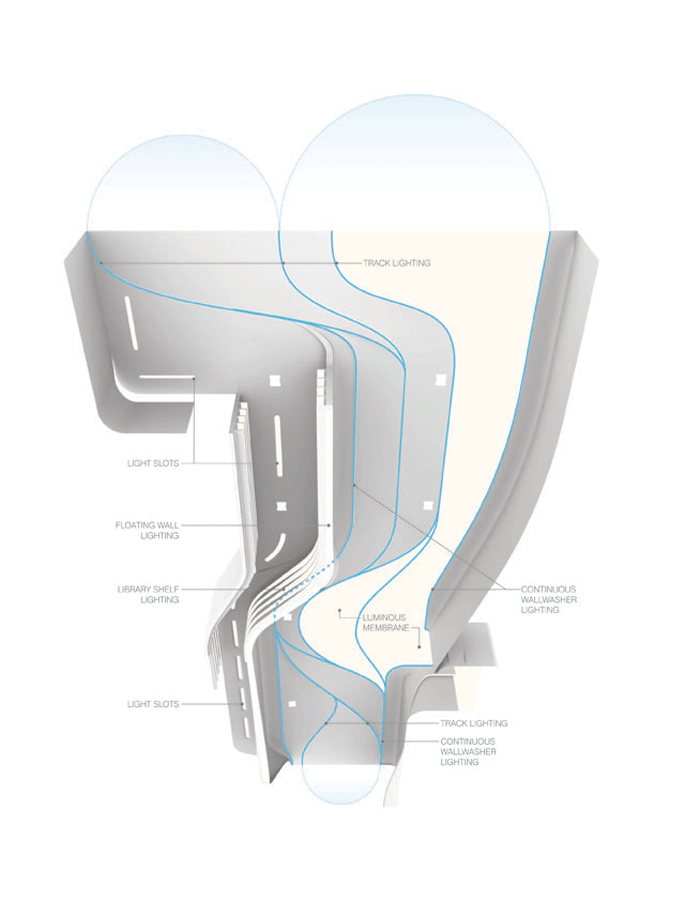
The new walls, which meander through the long and wide loft, are used to hang art and display books on self-lit shelves.
Living with Books and Art by UN Studio
18,000 LEDs sit behind light diffusers that span the ceiling and provide local and ambient light in variable shades.
Living with Books and Art by UN Studio
The existing fenestration has been replaced with ceiling-height windows to maximise views across downtown Manhattan.
Living with Books and Art by UNStudio
The curved walls are made of fibreglass reinforced with gypsum panels, while the floor has been finished with douglas-fir boards.
Living with Books and Art by UN Studio
Photographs are copyright Iwan Baan.
Here’s some more from the architects:

Living with Books and Art: a loft in New York, USA 2007-2010
The UNStudio design for an existing loft located in Greenwich Village in Manhattan explores the interaction between a gallery and living space. The main walls in the loft flow through the space, and together with articulated ceilings create hybrid conditions in which exhibition areas merge into living areas
History
The collector and the architect became acquainted several years ago when UNStudio was involved in the renovation and expansion of the Wadsworth Atheneum. That project was never realized, but soon after the collector spoke of his intention to have a house designed by his new friend, the architect. Over the years, the pair regularly visited possible sites for this new house in the suburbs of Hartford.
Then, in a phone call to Amsterdam in the early spring of 2007 the collector announced he had bought a loft space in Manhattan. The architect finally received his commission: not for a house, but for a home for the collector and his art and books.
Unifying Art and Urban Living
The design of the loft in downtown Manhattan mediates between art gallery and living space. The existing loft space was characterized by challenging proportions: the space is long and wide, but also rather low. Gently flowing curved walls were introduced to virtually divide the main space into proportionally balanced spaces. This created zones of comfortable proportions for domestic use, while simultaneously generating a large amount of wall space for the display of art.
The meandering walls frame an open a space that privileges long perspectives, with more sheltered corners and niches nestled in the curves. In this hybrid space exhibition areas merge into the living areas; a floating exhibition wall blends into library shelves on one side and into a display case on the other side. The client as collector had sought a space in which he could live comfortably while interacting with the many paintings, objects and books he has brought together over the years. The loft aims to merge life and art by facilitating these daily interactions, and by making clearer his own unusual way of seeing
Living with Books and Art by UN Studio
Field of Light
While the walls form a calm and controlled backdrop for the works of art, the ceiling is more articulated in its expression of this transition. By interchanging luminous and opaque, the ceiling creates a field of ambient and local lighting conditions, forming an organizational element in the exhibition and the living areas.
The opaque part of the ceiling consists of subtly arched elements that give a notion of an limitless ceiling which disguises the real height of the space
The luminous part of the ceiling is backlit by 18,000 led lights. This extensive membrane of light serves multiple purposes; it balances the proportions of the loft by creating an illusion of height, functions as unobtrusive space divider, and can be programmed to illuminate the space with various shades of light, from the coolest, most neutral daylight, to warmer tones. By interchanging between luminous and opaque, the ceiling becomes a field of ambient and local lighting conditions.
Framing the view
The third element that the architect has added to this mix is the appreciation of the city which is expressed in the ‘framing of the views’. The former windows in the South wall have been replaced by full floor to ceiling glass panes that frame and extend compelling views, over a full glass balcony, toward downtown Manhattan.
Materialization
The main walls and ceilings flow through the space, creating hybrid conditions in which exhibition areas merge into living areas; an exhibition wall blends into led illuminated library shelves on one side and a display case on the other. To enable this uniform and seamless space, partly double curved glass fiber reinforced gypsum paneling is used. Within these curved wall elements most of the technical installations like HVAC and lighting have been integrated.
As a last element a Douglas fir floor with 1½ feet wide planks covers the entire loft. The subtle, even-toned floor unifies the space and allows furniture and art to be positioned as floating elements in changeable constellations.
Living with Books and Art by UN Studio
Click above for larger image
New York, USA 2007
Client: Anonymous
Location: Greenwich Village, Manhattan New York, USA
Building area: 550 m2
Building Programme: Loft renovation into Apartment / Private gallery
Status: completed 2010
Credits
UNStudio: Ben van Berkel with Arjan Dingsté, Marianthi Tatari and Collette Parras
Advisors
Executive architect: Franke, Gottsegen, Cox Architects, New York. Team: Matthew Gottsegen, Bruce Harvey, Matt Shoor
Structural engineer: Wayman C. Wing Consulting Engineers, New York
MEP: P.A. Collins PE Consulting Engineers, New York
Lighting design: Renfro Design Group, Inc., New York
Contractor: 3-D Laboratory, Inc. New york