Monday, 17 September 2012

Think about car parts

Chinese Pavilion at Venice
Architecture Biennale 2012

| Leave a comment
Chinese Pavilion at Venice Architecture Biennale 2012
Bright lights, prime numbers and a map of the universe are installed amongst the abandoned oil tanks of a former shipbuilding workshop in what’s now the Chinese Pavilion for the Venice Architecture Biennale 2012.


Textasiða by Snæfríð Thorsteins
and Hildigunnur Gunnarsdottir
| Leave a comment

Textasiða, a typography exhibition by graphic designers Snæfríð Thorsteins and Hildigunnur Gunnarsdottir, was on show last month at Crymogea as part of DesignMarch 2012 in Rekjavic, Iceland.
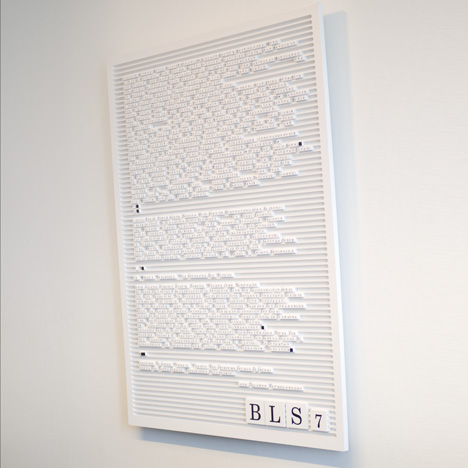
The exhibition comprised large wall-mounted tablets with racks of moveable letters like Scrabble tiles.

The letter blocks come in different sizes and allow the user to rearrange them to create messages and sayings.

The variations in the size of each letter block play with light and shadow, changing as the blocks are moved around. The exhibition also included a hand-bound book of Icelandic birds by Benedict Gröndal Sveinbjarnarson.

The images above were taken with the Pentax K-01 camera designed by Marc Newson, which was kindly given to us by Pentax for the trip. You can also see our architecture tour and studio visits from the trip, or watch an interview with Marc Newson talking about the camera on Dezeen Screen.


Pivot by Shay Alkalay
| 18 comments

These drawers by young Israeli designer Shay Alkalay were launched by Dutch brand Arco at the IMM Cologne furniture fair earlier this month.
Called Pivot, the unit rests against the wall and features drawers that pivot open rather than sliding.

Here’s some text about the piece from Alkalay:

Pivot
design by Raw-Edges, Shay Alkalay
This surprising cabinet is ideally suited to storing small items and everyday necessities in order to make sure these are always in the same place. Very useful during morning rush hour at home!
The solid wood cabinet is built on tall legs and features two drawers.


The innovative aspect of this cabinet is the fact that the drawers can hinge, making it possible to open both at the same time, which is impossible with a conventional set of drawers.
Available in: lacquer, solid oak, solid American walnut.
Shay Alkalay is a young Israeli designer. Having graduated from the Royal College of Art in London in 2006 (MA Design Products, Ron Arad’s Course) he is now designing in his own Raw-Edges Design Studio in London.


| 15 comments
Hiedaira House by Thomas Daniell Studio
This concrete house in Hiedaira, Shiga Prefecture, Japan, by Kyoto firm Thomas Daniell Studio, is located next door to the house and studio we published on Dezeen last week (see our earlier story here).
Hiedaira House by Thomas Daniell Studio
The entire building is made of exposed reinforced concrete, including the gabled roof, which has been treated to make it waterproof.
Hiedaira House by Thomas Daniell Studio
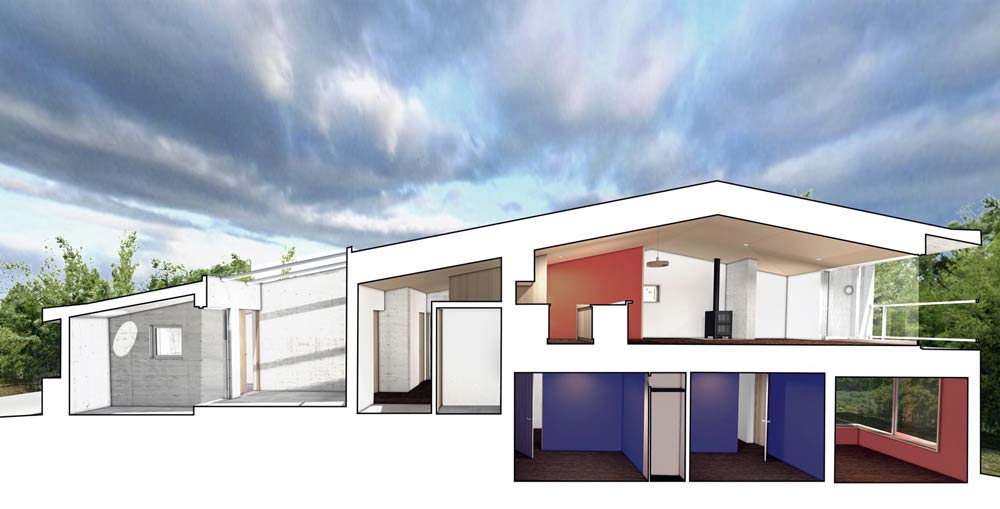
Built on a sloping piece of land, the house is a single storey at the front and expands into two stories at the rear.
Hiedaira House by Thomas Daniell Studio
Large windows in the bedroom and living room provide views of the surrounding landscape, which includes a national park.
Hiedaira House by Thomas Daniell Studio
All our stories featuring Japanese houses »
Hiedaira House by Thomas Daniell Studio
More residential architecture on Dezeen »
Hiedaira House by Thomas Daniell Studio
The following information is from the architects:

HOUSE IN HIEIDAIRA
This is a single-family house designed for a lush natural setting a new subdivision in the mountains above Kyoto.
Hiedaira House by Thomas Daniell Studio
The site slopes away to the north, facing onto a National Park, with a view across a forest toward Mt Hiei (the most sacred mountain in Japanese Buddhism).
Hiedaira House by Thomas Daniell Studio
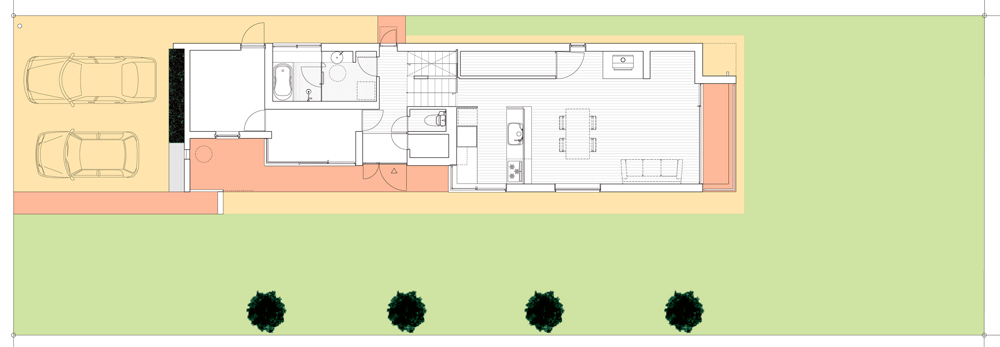
In compliance with new building regulations that mandate orthogonal walls and gabled roofs, the house takes the form of a nagaya (traditional row house): a linear sequence of rooms contained in a long, narrow volume aligned perpendicular to the street.
Hiedaira House by Thomas Daniell Studio
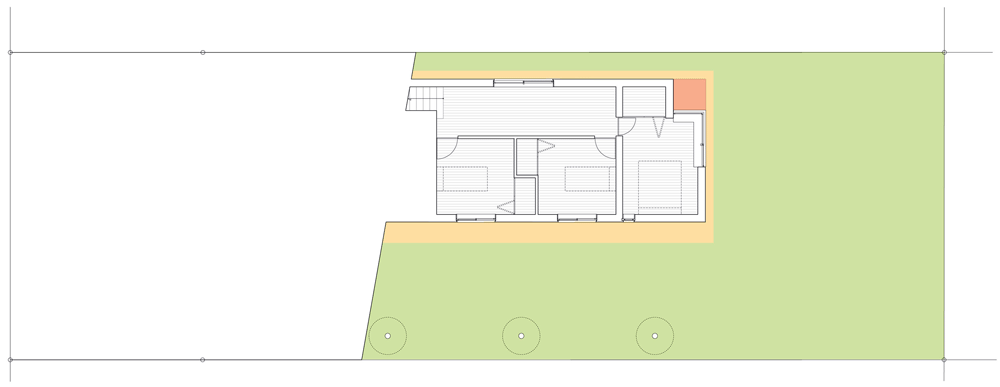
The house expands in section to follow the slope: single-story at the street façade, expanding to two stories at the rear of the site.
Hiedaira House by Thomas Daniell Studio
This allows the gabled roof shape to define the interior spaces rather than simply sit on top of them. The bedrooms are half buried, whereas the living area is oriented toward the mountains.
Hiedaira House by Thomas Daniell Studio
The historical nagaya type is a response to the narrow, deep sites in congested inner-city Kyoto, with little or no space between buildings, but in this semi-rural location the lot has been divided in half longitudinally, with building and garden set parallel and having approximately the same width and footprint.
Hiedaira House by Thomas Daniell Studio
The rooms are arranged as a band running along the western edge of the site, enabling natural light penetration into each room.
Hiedaira House by Thomas Daniell Studio
The location of the building gives maximum separation from the neighbor to the east, and hence maximum sunlight in the garden area that remains.
Hiedaira House by Thomas Daniell Studio
The overall nagaya form remains as abstract as possible, made entirely from bare concrete.
Hiedaira House by Thomas Daniell Studio
The roof has no cladding or surface membrane (an invisible waterproofing compound has been applied to the exposed slab) and there are no projecting eaves, making the house volume akin to something sliced from a block of tofu.
Hiedaira House by Thomas Daniell Studio
There are no drains, downspouts, or gutters — or more precisely, the entire roof plane has been subtly shaped to become an enormous rainwater channel.
Hiedaira House by Thomas Daniell Studio
The roof perimeter slopes gently upwards, creating subtle parapets that prevent water from falling down the long walls, channeling it all to the building’s north and south ends where it may fall freely to the ground.
Hiedaira House by Thomas Daniell Studio
Architect: Thomas Daniell (assistants: Fumihiko Nakamura, Mike Heighway)
Hiedaira House by Thomas Daniell Studio
Click for larger image
Contractor: Shimizu Corporation
Location: Hieidaira, Otsu City, Shiga Prefecture, Japan
Hiedaira House by Thomas Daniell Studio
Click for larger image
Program: Single family house (2 adults, 2 children)
Area: 136m2 (two stories)
Hiedaira House by Thomas Daniell Studio
Click for larger image
Construction: September 2008-May 2009
Structure: reinforced concrete


Tour Végétale de Nantes by Edouard François
| 15 comments
Tour Végétale de Nantes by Edouard François
Plants adapted to thrive in rocky crevices will take over the facade of this tower for Nantes by French architect Edouard François.
Tour Végétale de Nantes by Edouard François
Plants will grow inside stainless steel tubes on the Tour Végétale de Nantes.
Tour Végétale de Nantes by Edouard François
The tubes will take up little space on each host balcony but will provide leafy surroundings for inhabitants while showcasing species collected by the local botanical gardens.
Tour Végétale de Nantes by Edouard François
The building will comprise a plinth containing retail and parking, offices enclosed in a black rubber cube and the residential tower with shifting, elliptical balconies.
Tour Végétale de Nantes by Edouard François
François is renowned for architecture that incorporates plants, including the Parisian Eden Bio social housing development completed in 2009. More details in our earlier story.
Tour Végétale de Nantes by Edouard François
More stories about plants on Dezeen »
The information below is from Edouard François:

This operation situated in the future eco-neighborhoods, Prairie-au-Duc, in Nantes, is unique in particular because of its height. Its main challenge is to (re) create the desire to live in tall buildings, in a remarkable setting in the heart of the town.
This mixed project consists of a base of shops and parking, on which is placed in a black rubber cube of offices and a housing tower of 17 storey (60m).
The tower consists of a main body ringed by elliptic balconies. The balconies vary from floor to floor to form a giant organic silhouette.
The tower is the support for a collection of chasmophites plants coming from the collections of the botanical gardens of Nantes. These plants have been collected by scientists from the whole world and frozen. The building will show the plant collection of the city.
The originality of the plantation is to grow in long stainless steel tubes (diameter: 12cm/length: 4meters ). These tubes recreate the natural conditions of the chasmpophite plants that grow in rocky mountain flaws. A scientific experiment is currently underway for over a year in the botanical gardens of Nantes, to test the viability of the plantation process. The result of this experimentation shows that the growth of plants is exceptional for a very low water consumption.
The impact of the tubes on the balconies is minimal. On the other hand on the facades, they form vertical dynamic lines.
Tour végétale de Nantes
Architect : Edouard François – int. FRIBA
Botanist : Claude Figureau
BET : AIA-SERA
Client : Groupe Giboire
Ilot A2 – Prairie aux Ducs – Ile de Nantes – Nantes
Planning : Concours Déc. 2009 – Livraison 2012
Program 9150 m² :
7500 m2 – appartments 6 240 m² (85 à 90 units)
2000 m2 – office,
350 m² – activity
91 parking places

To be changed. Look at later as if the roof is the wall.

Theoretical Block by Áron Lõrincz
| Leave a comment

Visualisation artist, architect and designer Áron Lõrincz has sent us a short movie that takes a real communist-era tower block in Budapest and imagines it extruded beyond our atmosphere.


Common Ground/Different Worlds
by Noero Architects

| 1 comment
This movie by filmmakers Stretch documents the ongoing work by Cape Town studio Noero Architects to create a cultural centre within the barracks of Port Elizabeth that were once used as a concentration camp.
Common Ground Different Worlds by Noero Architects
The barracks were dismantled and reassembled in Red Location Precinct after the Boer War, before becoming the first community of black African families in South Africa during the racial segregation at the start of the twentieth century.
Common Ground Different Worlds by Noero Architects
Noero Architects have designed a complex centred around a museum for the centre of the historic settlement, which is under construction and due for completion in 2022.
Common Ground Different Worlds by Noero Architects
“We thought, what better place in Port Elizabeth than to use Red Location as the new cultural centre of the city?” explained Jo Noero. “Where you could bring together the histories of the Afrikaner people and the histories of the black African people and show that they both suffered in different ways at different times, under different groups and regimes. In a way it was about talking about a real form of reconciliation.”
Common Ground Different Worlds by Noero Architects
The movie was completed after the opening of the exhibition and shows some of the completed buildings of the project and how they fit in amongst the existing urban fabric.
Common Ground Different Worlds by Noero Architects
“The best public space in South Africa is the street and the way in which life happens along its edges,” said Noero. “What we did at Red Location was to reinforce the idea of street and where we make bigger spaces we simply created indentations in the buildings which come directly off the street”.
Common Ground Different Worlds by Noero Architects
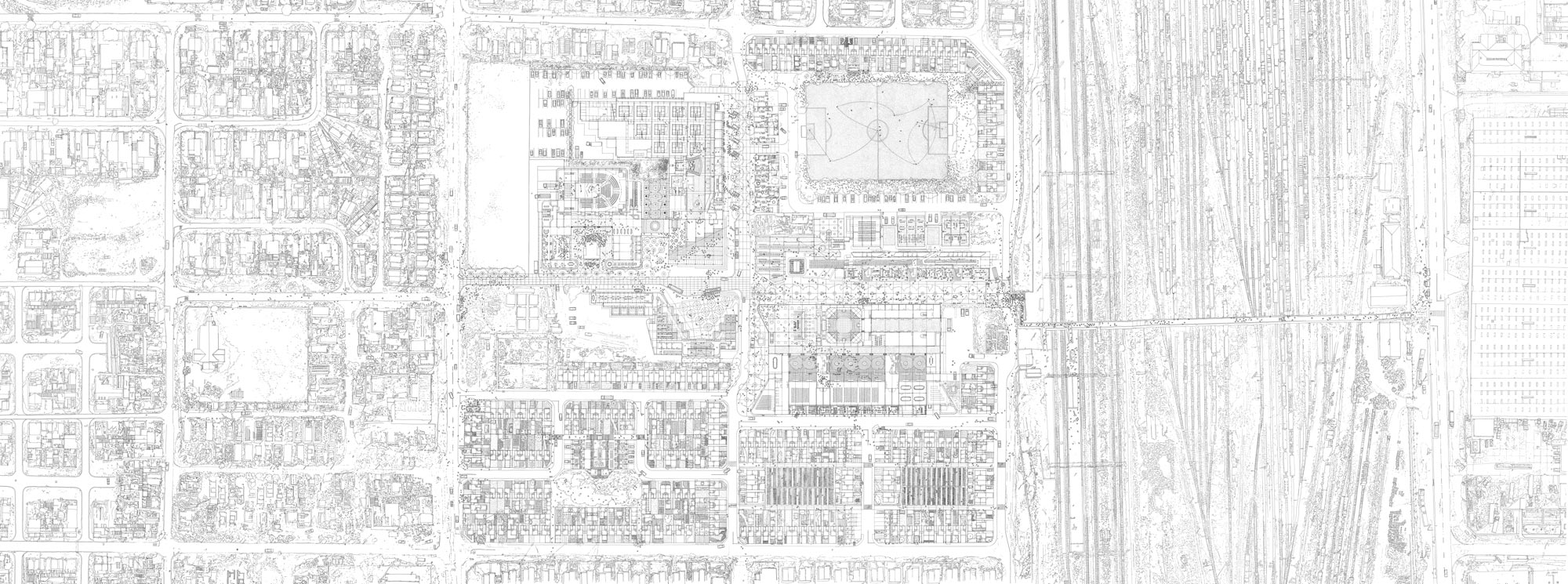
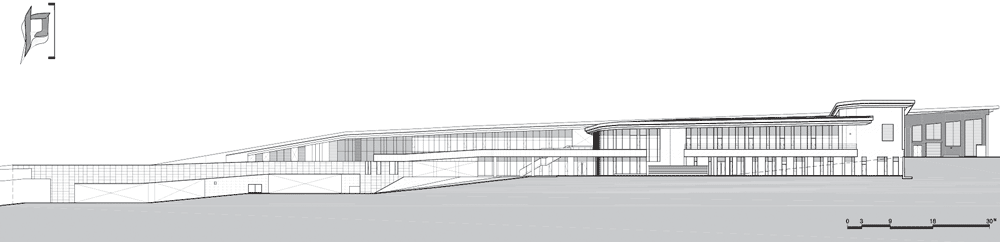
Plan detail – click above for larger image
Noero has also produced a nine-metre-long, hand-drawn plan to illustrate the proposals, which he is presenting at the Venice Architecture Biennale.
Common Ground Different Worlds by Noero Architects
When discussing the use of hand drawings, Noero said “there is nothing that the computer can do that can replicate that sense of control that you have by drawing by hand. When you draw by the hand you connect with your mind and your heart, and it is an action that you can control.”
Common Ground Different Worlds by Noero Architects
See more stories from the Venice Architecture Biennale »
Common Ground Different Worlds by Noero Architects
Here’s a few lines of text about the exhibition:

“South African Architect Jo Noero’s work has always been sensitive to the divided and contested urban conditions of his country’s cities, and his installation here reflects thus through two powerful artworks.
Common Ground Different Worlds by Noero Architects
Above: exhibition at the Arsenale Corderie
One is a 9m-long hand drawing, depicting at 1:100 the Red Location Precinct in Port Elizabeth, a project that proposes common ground in a city torn apart by the urbanistic consequences of apartheid. Next to it is the artwork Keiskamma Guernica, a tapestry made by fifty women from the Hamburg Women’s Co-operative from the Eastern Cape.
Common Ground Different Worlds by Noero Architects
Above: exhibition at the Arsenale Corderie
These two meticulous, labour-intensive works are contrasting and complementary pieces of evidence of an urban condition where common ground is not easily achieved.”

Wednesday, 12 September 2012

Pimlico School, John Bancroft

File:Pimlico school entrance.jpg


http://www.annastathaki.com/index.php?/root/wallpapercom/


PimlicoSchool.jpg


Project facts

  • Location: London
  • Country: UK
  • Year of Completion: 1970
  • Client: Unknown
  • Architect: Architects' Department of the Greater London Council John Bancroft
  • Size: Not known
  • Pupils: Not known
  • Construction Sum: Unknown

Overview

Pimlico school was demolished at the start of 2008 amidst an acrimonious debate as to whether this icon of the so called ‘brutalist’ architecture should be saved. The much derided style which is often branded inhumane is disappearing fast and although loved by many architects, public opinion tends to sway towards removing such buildings from the landscape. Pimlico comprehensive school will be re-built as Pimlico Academy in the near future, and it remains to be seen if the school’s new home will be as innovative or controversial as its previous one.
Pimlico school’s appearance was nothing if not striking. Many thought it had a nautical appearance. Part of this aesthetic comes from the elimination of external walls and roofs, which mean a series of planes are folded over to create the building envelope, more akin to naval architecture than land bearing construction. This enabled large areas of glazing to be utilised, creating a light interior. The design of circulation in and around the building was incredibly efficient, with a central internal concourse running the length of the building, reducing the need for meandering lengths of narrow corridors.

Themes

Integrated flexibility for space and learning
The integrated nature of the building form, rather than a series of individual or grouped buildings, enables all of the schools activities to take place under one roof. The main assembly halls, swimming pool and gym are all integral elements in the school building, providing a very compact layout. In order to accommodate all these elements some clever spatial planning was undertaken, with halls being raised up and the pool being sunk into the ground.
Integrated social and physical context
Conceived in the 1960s the building represented a bright new future for architecture and education. The design brought together new construction techniques and conceptual ideas to create a building that acted as a physical symbol of progress, development and learning for the surrounding area.
Innovative solutions to specific areas or smaller spaces
There are a number of innovatively designed spaces within the school that merit further investigation;
The in-the-round assembly hall occupies a lofty position at the top of the building, and represents an egalitarian approach to meeting and performance. The library is a beautifully proportioned space, with a double height central space appropriate for a reading hall and lower ceiling around the edges that is more suitable for individual quiet study. A series of greenhouses run along the edge of the building, connecting the building back to the ground and encouraging the production of food by pupils.
Many of the large strips of glazing are canted to face the sky, with a similarly inclined window sill, encouraging every to look up and be aspirational.

Sources

The Twentieth Century Society, The Pimlico Comprehensive School Website

Building Design Online, 7 March 2008, Demolition of Pimlico School Begins Website


http://www.imagineschooldesign.org/detail.html?&tx_ttnews%5Bpointer%5D=19&tx_ttnews%5Btt_news%5D=3&tx_ttnews%5BbackPid%5D=5&cHash=e1af9ee0d7


In the first of three movies filmed at the Venice Architecture Biennale, Reinier de Graaf of OMA talks about Pimlico School, a brutalist building in London that was demolished last year and which features in OMA’s Public Works exhibition of “masterpieces by bureaucrats” at the biennale.
Reinier de Graf of OMA on masterpieces by bureaucrats
Pimlico School was designed by John Bancroft of the Greater London Council’s architecture department and was constructed in the 1960s. Its demolition to make room for a new building followed a long campaign to have it listed. ”The architect campaigned very actively but he wasn’t a star architect,” de Graaf told Dezeen. “They took him to the demolition site and all he could murmur was ‘bloody fools, bloody fools.’”
Reinier de Graf of OMA on masterpieces by bureaucrats
De Graaf explains that although they weren’t credited by name for their work, architects working in government departments during the 1960 and 1970s created buildings with “enormous vitality and an impressive social mission.”
Reinier de Graf of OMA on masterpieces by bureaucrats


Monday, 13 August 2012

Seoul Memorial Park

Seoul Memorial Park
by HAEAHN Architecture


Seoul Memorial Park by HAEAHN Architecture
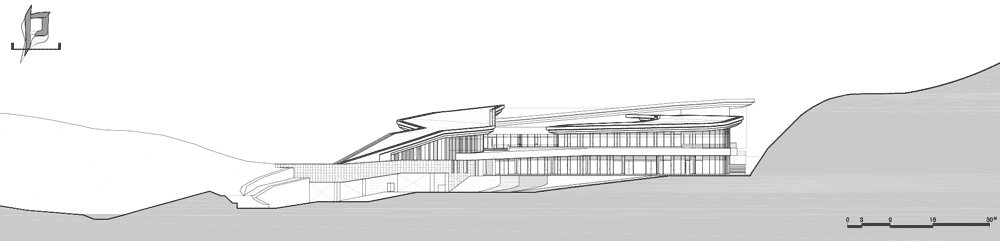
This crematorium in Seoul by Korean firm HAEAHN Architecture folds up from the landscape and curls around a peaceful courtyard and pool of water.
Seoul Memorial Park by HAEAHN Architecture
Gardens and ponds run alongside the two-storey building, while grass and plants cover the entire roof.
Seoul Memorial Park by HAEAHN Architecture
Visitors enter beneath a sheltered canopy, before following a procession through the building that trails around the courtyard and ends at one of the gardens.
Seoul Memorial Park by HAEAHN Architecture
Skylights bring natural light into the building from above and are reflected in the polished marble floors.
Seoul Memorial Park by HAEAHN Architecture
We’ve previously featured a few crematoriums, including one with fortress-like walls and dozens of square windows.
Seoul Memorial Park by HAEAHN Architecture
Photography is by Park Youngchae.
Seoul Memorial Park by HAEAHN Architecture
Here’s some more text from the architects:

Seoul Memorial Park
Secluded by mountain hills from a bustling highway gateway, Seoul Memorial Park rests in a serene valley area of the Woo-Myun Mountain on the outskirts of Seoul, South Korea. Seoul Memorial Park is a crematorium constructed in harmony with the natural terrain of the site, which previously lent calming scenic views to meditative passing-by hikers, and is now converted to a sanctuary for solemn rituals concluding life’s journeys.
Seoul Memorial Park by HAEAHN Architecture
Canvas for Land Art
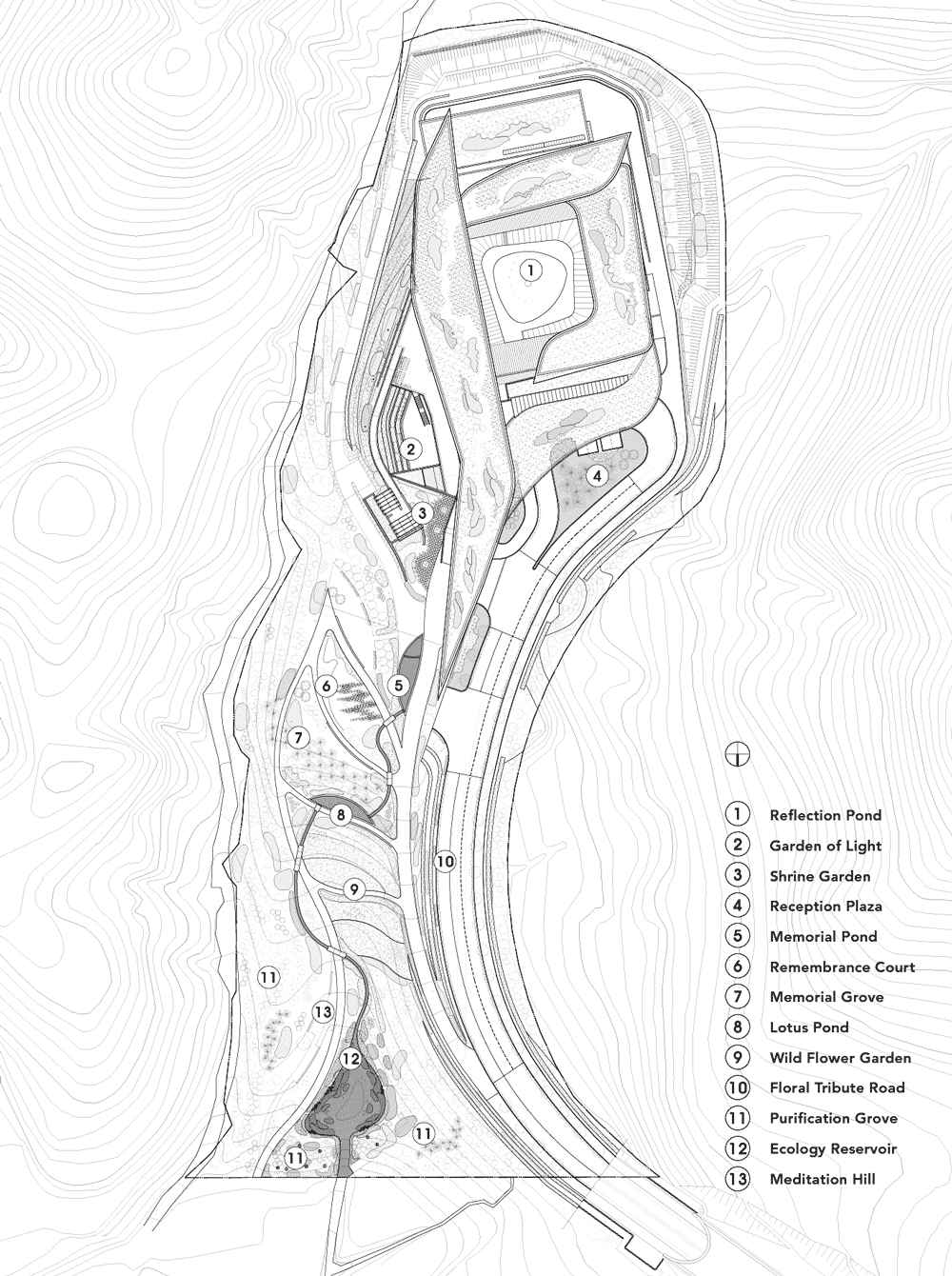
To overcome the unwelcomed response from the community, this crematorium was sought to be a “non-erected” building. Instead, Seoul Memorial Park emerges as a form of “land art” sculpted into the existing topography with a flowing array of architectural forms and motifs. Concaved at the center of the Park, lies a courtyard encompassed by a series of ritual spaces devoted to separate functions.
Seoul Memorial Park by HAEAHN Architecture
Site plan – click above for larger image
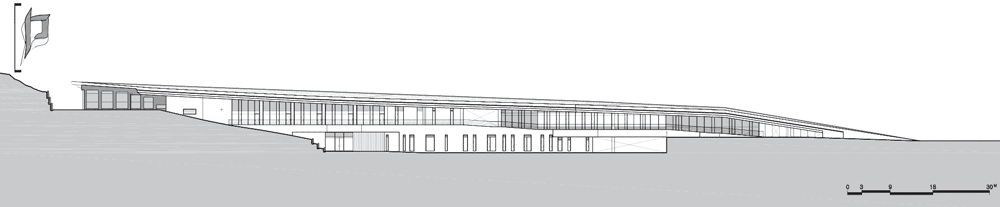
These spatial layers bordering the courtyard resonate from a distance with the surrounding mountain trails and ridges. The 2-storey high crematorium facility configured in the curvilinear belt along the courtyard has roof structures linked in the way flower petals pinwheel one another, punctuated by a reflective pool at the very heart of the courtyard.
Seoul Memorial Park by HAEAHN Architecture
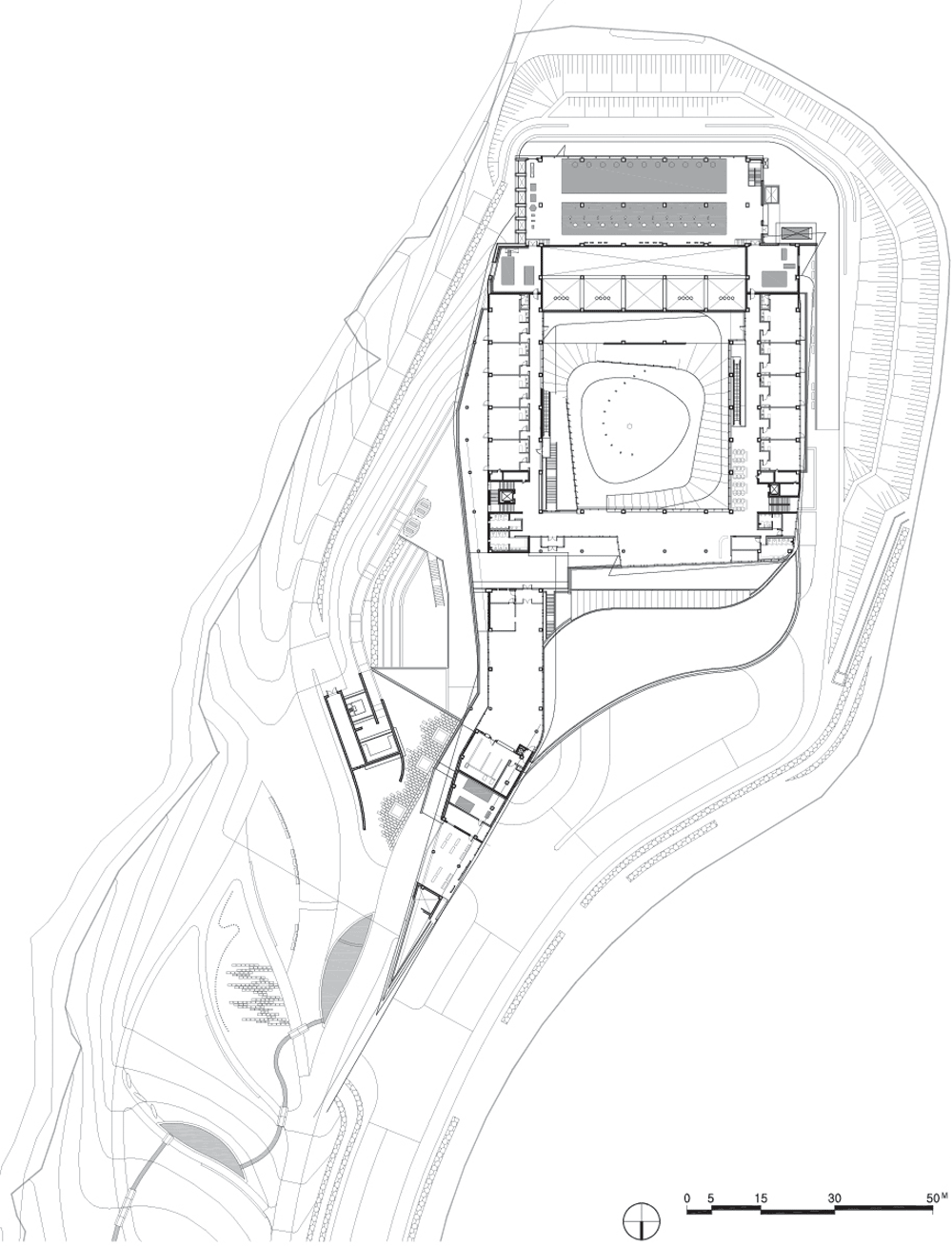
Ground floor plan – click above for larger image
Comfort in the Final Journey
Families in bereavement take the final journey of parting as they encircle the courtyard along a path reminiscent of spiritual spaces with vaulted ceilings and indirect lighting. Towards the cremation alcove, the ceiling rises drastically as a clearstory above a triforum. Upon completion of the path, a meandering garden comforts the bereft.
Seoul Memorial Park by HAEAHN Architecture
East elevation – click above for larger image
As the water from the mountain flows down and gives life to the garden, one might be reminded of the transfiguration of sorrows in praise of the harmony in nature. The garden shimmers with sunlight, whispers with snowfalls, and dances with spring rains. Season by season, tranquility is discovered and the spirit is renewed. Just as nature was dissolved into a building to rest in the valley, Seoul Memorial Park was embodied in a piece of land art to celebrate life and transfigure sorrows.
Seoul Memorial Park by HAEAHN Architecture
North elevation – click above for larger image
Date of Completion: 2012
Site Area: 36,000 m2
GFA: 18,000 m2
Client: Seoul Municipal Facilities Management Corporation
Seoul Memorial Park by HAEAHN Architecture
West elevation – click above for larger image
2009 winning competition entry and 2012 built project by HAEAHN architecture.

Tuesday, 24 July 2012

Lighting silhouette of house

Building Tilelamp at Casa do Lado
by 20.87

4 comments
Brazilian studio 20.87 has used plastic panels and LED lighting to transform an old house in São Paulo into a giant lamp (+ slideshow).
Building Tilelamp at Casa do Lado by 20.87
The translucent corrugated panels were screwed to a wooden frame placed around the building, allowing the lighting mounted around the edges of the facade to diffuse through.
Building Tilelamp at Casa do Lado by 20.87
The former house is located beside design store MiCasa and is used as a gallery for design exhibitions.
Building Tilelamp at Casa do Lado by 20.87
A previous installation we’ve featured at the building consisted of metal tubing and lamps wrapped around the inside and outside – see it here.
Building Tilelamp at Casa do Lado by 20.87
See more projects in Brazil.
Building Tilelamp at Casa do Lado by 2087
Read more details from the designers below:

The project was developed as a request of design store MiCasa. It consists of the scenographic customization of the adjacent building to the store, in order to host an art exhibition in its interior.
Building Tilelamp at Casa do Lado by 20.87
After the concept was defined, the construction lasted approximately four weeks. To start with, we decided where the LED tapes would be placed.
Building Tilelamp at Casa do Lado by 20.87
Simultaneously, we constructed a wood structure to receive the tile covering.
Building Tilelamp at Casa do Lado by 20.87
With the conclusion of the installation of the lighting, the structure was fixated on the walls of the house at a distance of 20 centimeters from the original construction in order to leave a space between the wall and the tiles, making the lighting more subtle and correcting any sort of irregularities that could be present in the surface of the walls.
Building Tilelamp at Casa do Lado by 20.87
The tiles were custom made for the project and fixated with screws.
Building Tilelamp at Casa do Lado by 20.87
The permanence of the installation is of approximately 6 to 10 months, for a new building will be constructed in the same ground afterwards.