Friday, 28 October 2011

Jardin de la Connaissance by Rodney LaTourelle and 100 Landschaftsarchitektur


Jardin de la Connaissance by Rodney LaTourelle
and 100 Landschaftsarchitektur

Jardin de la Connaissance by Rodney LaTourelle and 100 Landschaftsarchitektur
Mushrooms grow on decaying books at this garden in Quebec by Berlin landscape architect Thilo Folkerts of 100 Landschaftsarchitektur and Canadian artist Rodney LaTourelle.
Jardin de la Connaissance by Rodney LaTourelle and 100 Landschaftsarchitektur
Called Jardin de la Connaissance, the installation is part of the International Festival des Jardins de Metis, which continues until October.
Jardin de la Connaissance by Rodney LaTourelle and 100 Landschaftsarchitektur
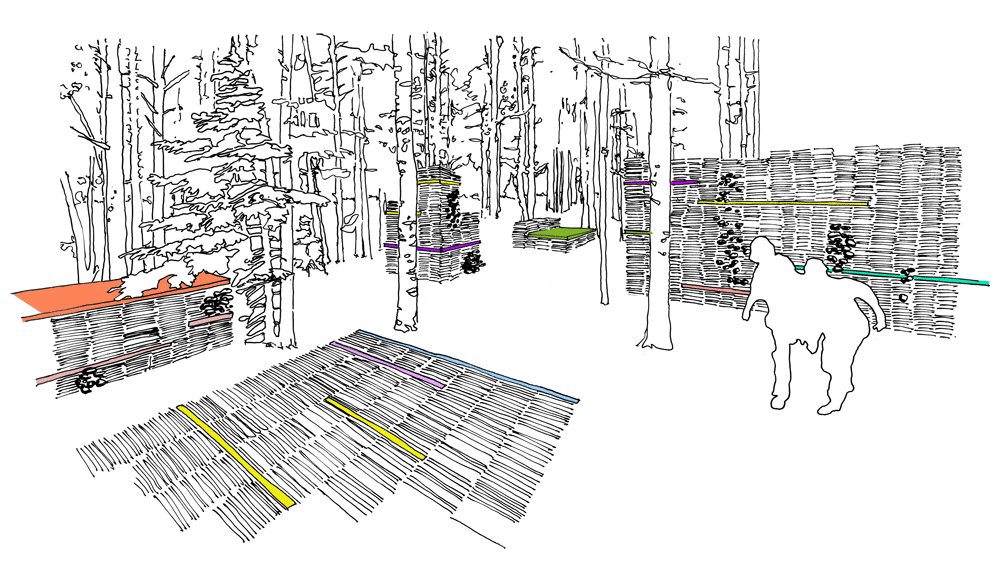
The books are piled up to form walls, rooms and seats, and partially submerged in the earth to become flooring.
Jardin de la Connaissance by Rodney LaTourelle and 100 Landschaftsarchitektur
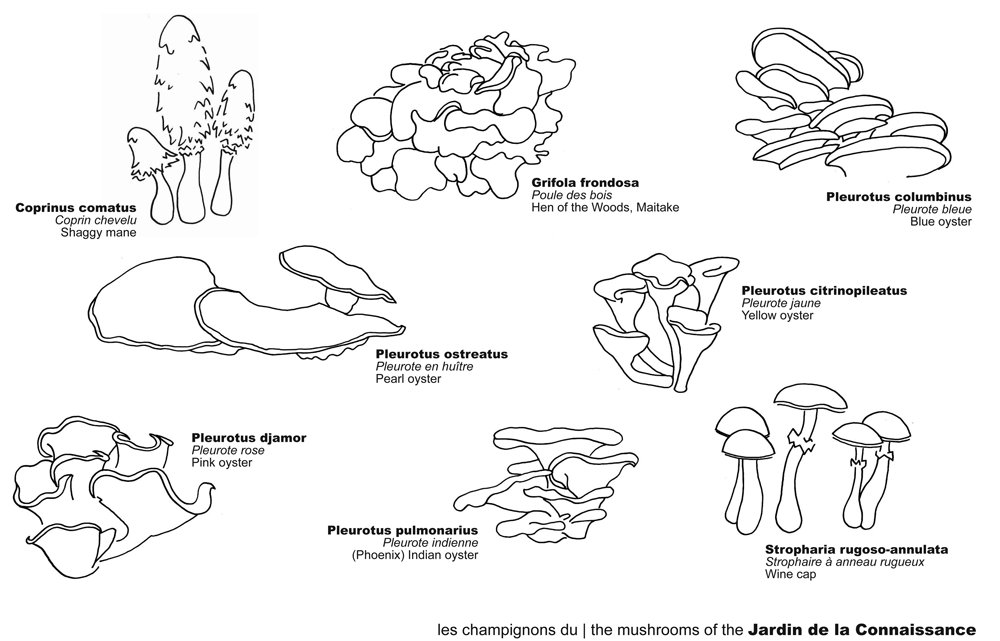
Eight varieties of mushroom are cultivated on selected books, speeding their decay into the landscape.
Jardin de la Connaissance by Rodney LaTourelle and 100 Landschaftsarchitektur
Here’s some more information from Folkerts:

100Landschaftsarchitektur Thilo Folkerts, Rodney LaTourelle, Berlin
Jardin de la Connaissance, Metis (CA), 2010
International Festival des Jardins de Metis (Quebec), Canada
By introducing the book as a material in the formation of spatial elements within the landscape, Jardin de la Connaissance offers an evocative cultural frame to examine transformational processes inherent in the nature of the forest. Walls, benches and floors made of used books structure a series of rooms at once framing and dissolving into their environment.
Jardin de la Connaissance by Rodney LaTourelle and 100 Landschaftsarchitektur
Invoking the mythic relation between knowledge and nature integral to the concept of ‘paradise’, we invite the emotional involvement of the visitor by exposing these fragile and supposedly timeless cultural artefacts to the processes of decomposition.
Jardin de la Connaissance by Rodney LaTourelle and 100 Landschaftsarchitektur
The decaying books are organized between structural coloured plates, while their deterioration is further stimulated and accentuated by varieties of mushrooms that will be cultivated on selected editions. The garden becomes a sensual reading room; a library; an information platform; an invitation to a provocative realm of knowledge.
Jardin de la Connaissance by Rodney LaTourelle and 100 Landschaftsarchitektur
Thilo Folkerts is a landscape architect, teacher, writer and gardener. He founded the office 100Landschaftsarchitektur in Berlin in 2007. He has realized temporary and permanent gardens all over Europe. Rodney LaTourelle is a Canadian artist, writer and designer, based in Berlin.
Jardin de la Connaissance by Rodney LaTourelle and 100 Landschaftsarchitektur
Click above for larger image
His artistic approach is informed by his education in architecture and landscape architecture. His site-specific installations have been exhibited internationally. They have worked together on this project that revitalizes the notion of gardening as an art form.
Jardin de la Connaissance by Rodney LaTourelle and 100 Landschaftsarchitektur
Click above for larger image
Garden site: ca. 250 m2
ca. 40.000 books = 30-40 tons
Mushrooms:
Coprinus comatus (Shaggy Mane).
Grifola frondosa (Hen of the Woods, Maitake).
Pleurotus citrinopileatus (Yellow Oyster).
Pleurotus columbinus (Blue Oyster).
Pleurotus djamor (Pink Oyster).
Pleurotus ostreatus (Pearl Oyster).
Pleurotus pulmonarius ((Phoenix) Indian Oyster).
Stropharia rugoso-annulata (Wine Cap)

H&M Seoul by Universal Design Studio


H&M Seoul by Universal Design Studio

H&M by Universal Design Studio
Architects Universal Design Studio have created a perforated pleated facade for clothing retailer H&M in Seoul, South Korea.
H&M by Universal Design Studio
Each facet of the facade is perforated with patterns at different scales to increase the surface’s tonal contrast and perceived depth.
H&M by Universal Design Studio
The project also involved creating an internal staircase, this the studio lined with vertical louvres.
H&M by Universal Design Studio
The design is to be rolled out across stores worldwide.
H&M by Universal Design Studio
The following text is from Universal Design Studio:

H&M, Seoul, Korea
Building on the continuing success of their work for international fashion brand, H&M, Universal Design Studio has now designed the exterior façade for the Korean flagship store in Seoul. This, the tenth site for H&M, is based on the distinctive modular design of other locations such as the H&M store in LA.
Universal Design Studio has accentuated the three-dimensional appearance of the facade by using small and large-scale perforations to produce tonal contrast and visual depth to the pleated cladding. The façade comes alive at night when concealed illumination turns the store into a dramatically lit beacon. The three-storey-high sculptural relief creates an effect that softens the hard, dominant lines of the existing building structure.
Internally, the design also includes a concept staircase created from a ‘ribbon’ of white glass. This forms the internal balustrade, and an articulated shroud of tightly stacked vertical louvers form the external walls.
Universal Design Studio’s rolling project with H&M is an example of their ability to tailor solutions to individual sites whilst still creating engaging spaces and brand continuity. The original brief was to create an iconic façade concept that could be used to brand the first Asian H&M flagship stores but the design has proved so successful that it is now used as H&M’s global identity and will be applied to stores all over the world.
Now established as two of the leading names in British design, Edward Barber and Jay Osgerby set-up BarberOsgerby together in 1996 and Universal Design Studio in 2001.
Universal Design Studio is a multi-disciplinary team of architects, interior designers and industrial designers specialising in the creation of unique built environments. The studio takes a consistent, holistic approach to spatial design and interior architecture and offers a profound understanding and interpretation of the full range of creative possibilities.

Saturday, 22 October 2011


House M by AE5 partners
A grid of timber louvres screens the end facades of this Japanese house by architectsAE5 Partners.
House M by AE5 partners
A fold in the middle of the two-storey House M divides it into two symmetrical halves.
House M by AE5 partners
Openings on both sides of the fold create entrances leading into an open-plan living room on one side of the house and bathrooms on the other.
House M by AE5 partners
A mezzanine library overlooks the living room from the floor above, while a bedroom is located opposite.
House M by AE5 partners
Another gridded timber screen inside the house creates a first-floor balustrade.
House M by AE5 partners
You can find more Japanese houses on Dezeen, including one with slides between floors, by clicking here.
House M by AE5 partners
Photography is by Nacasa & Partners.
The following information is from the architects:

House M, Kaga-shi Ishikawa-ken Japan
Context
Along a series of lushly green mountains narrow rice field terraces are divided by a mountain stream.  Surrounded by this complicated yet beautiful, abundant nature, a settlement can be seen in Kashiwano-machi, a town in Kaga city, Ishikawa, Japan.
House M by AE5 partners
The project site was established in an gap between a national road and the edge of the city. How should the building be designed to fill the space in of a town that was slowly built up over a long period of time by people and nature? The foundational concept of the plan should proceed from the climate, the culture, and the historical context and, what is more, it should express modernity. It was thought that this approach may be necessary and most natural for the residents and town people.  A “Kura” (Japanese warehouse) is a feature of the typology of the town. It is a secondary house that can be seen anywhere since every house in the town has a Kura.
House M by AE5 partners
With small, aesthetic proportions, it fills the space and distance between houses and it helps block the prying eyes of neighbours. It can be said that the planning site complies with the traditional construction style of the town: a house like a Kura with a few open doors is built between a busy national road and the head house in which the client family lives.  Additionally, the volume of a Kura suits the current “a house for a woman living alone” theme.
House M by AE5 partners
While moving forward with the plan, the typological aspect of the Kura was used within the constraints of the building’s site and context to specialise the process. The process begin like this: a decision was made using a volume study that maintained the proportions of the dialogue between the building plan and the surrounding environment. Then, between the head house and the building plan, a chevron shaped courtyard was made way for, creating a complete assembly whose plan is known as Kunoji. Between the Kunoji and the main house the space became a welcoming courtyard and, at the same time, the north-western side of the Kunoji produced a small space that answered the client’s request of having a private garden.  Via this process an architectural shape that acts as a part of the town was derived.
House M by AE5 partners
Geometry
 Embracement / Louvered Facade
Kuras stand with dignified and steady beauty. To acquire the shape, the building’s level surfaces and the exterior were designed with appropriate geometric proportions. The flat surfaces use two squares and isosceles triangles. The elevated surface toward the Tsumagawa (the side that contacts the ridge at a right angle) was constructed using Silver Ratios. The one of a Kura’s features is that it has only a few open doors. This relates to the house owner’s privacy. It is carefully designed to protect the dwellers privacy; The Tsumagawa facade was changed to wooden louvers so that it gets bright daylight; the wooden pieces are arranged to face in a constant direction at every other step.
House M by AE5 partners
The intent of the configuration of all of the louvers references the concept of “order and the unexpected”. There is an old persimmon tree in front of the louvers that was planted a long time ago. At first glance the randomness with which the branches and leaves grow seems to have a constant regularity which, when combined with the louvers opposite, abides by the concept of “order and the unexpected” to create a dialogue between nature and the architecture. Additionally, a polygonal shape was used to design the top lights placed on the 2nd floor terrace above and the open windows facing the road.  Doing so, the contrast of the order (mathematically proportioned) in the flat and elevated surfaces against the free lines of the open windows attempts to bring into being a pleasantly designed harmony. The lights coming from the open windows or wooden louvers change seasonally and, according to the time of day, produce a rich tapestry of colour for an entire lifetime. On the other hand, the lights of the open windows add small flares of colour and warmth to evenings wrapped in silence or seasons covered in snow.